
Jones County Arrest Records and Charges
Jones County arrest records begin on the law-enforcement side. The official Jones County Sheriff's Office app and public inmate feed show booking-style information such as inmate name, inmate ID, age, race, gender, booking date, total bond amount, and charge text. The inspected official feed included entries for simple battery family violence, probation violations, parole violations, DUI, marijuana possession, obstruction, bench warrants, theft, aggravated assault, and other listed charges. Those entries can be useful for a fast custody check, but a roster charge is still a snapshot.
Formal Jones County court charges after arrest are different. A prosecutor may file an accusation, indictment, or other charging document, and the court record then tracks arraignment, motions, plea, disposition, sentence, and probation. The Jones County criminal court records file is the better place to confirm the case outcome, while the jail roster is better for booking status, bond, and custody. Read both sources together before treating a charge as current.
The official sheriff homepage is captured in the manifest. The Jones County Sheriff's Office web app is the local entry point for jail, wanted, bonding, and app-based tools.

The app-backed sheriff site matters because several arrest, booking, bond, and wanted features live there instead of in the clerk's court portal.
Find Jones County Arrest Records
Start with the source that matches the question. For a custody or bond question, use the sheriff inmate feed or call the Jones County Jail. For a filed criminal charge, use the Clerk of Superior Court records channels, re:SearchGA if available to the user, or a copy request through the clerk. For prosecution status, focus on the DA and court filing path rather than the first booking label.
- Search the official sheriff inmate feed for a current or recent booking when the issue is custody, listed charges, or bond.
- Check the Clerk of Superior Court case search or request records from the clerk when a charge has become a Superior Court criminal case.
- Compare the booking charge with the filed accusation, indictment, plea, disposition, or sentence when those records exist.
- Confirm statewide criminal-history questions through Georgia Felon Search or the Georgia Bureau of Investigation record-restriction process when the issue is a criminal-history report.
The official inmate feed is one of the fastest places to see arrest-charge language. The manifest image from the OCV inmate feed reflects the sheriff app data source used for public booking entries.
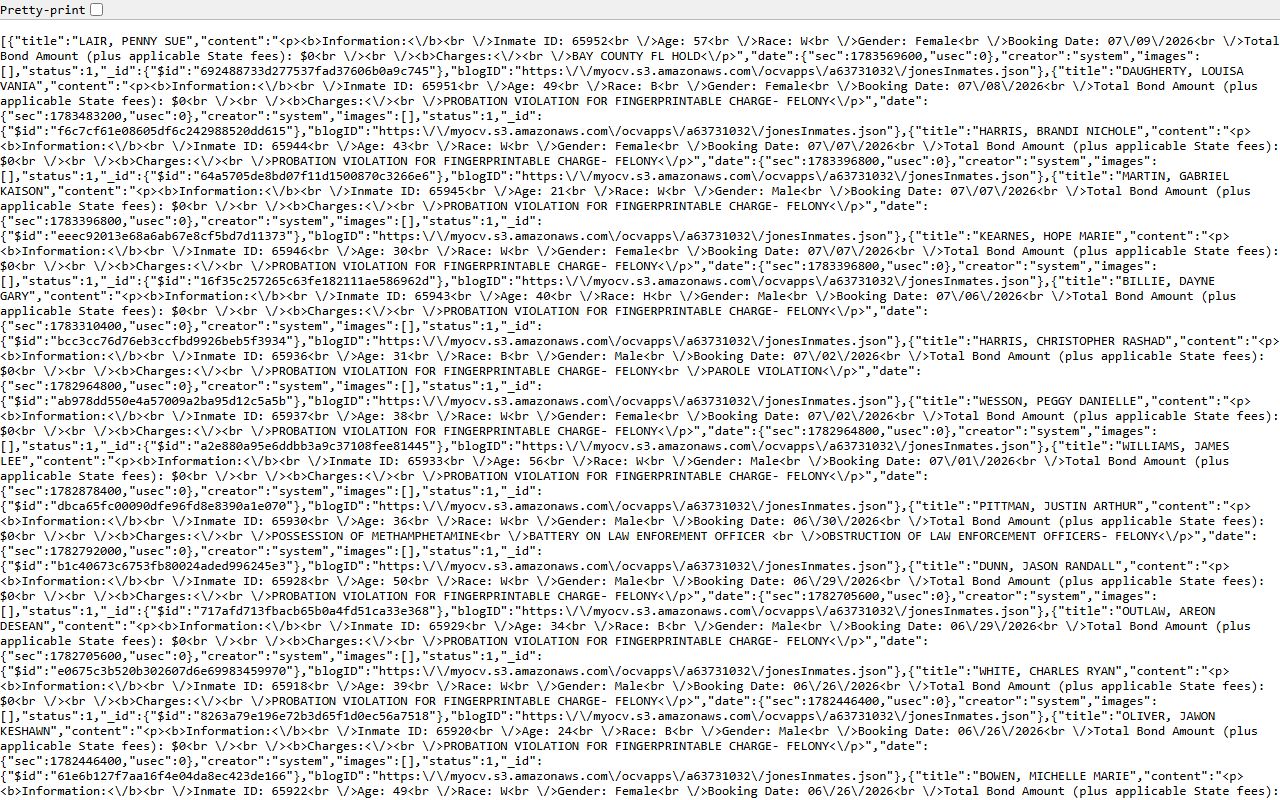
That feed can list charges and bond, but it does not replace the filed court record or show every docket event in a criminal case.
Jones County Court Charges After Arrest
Charge information can appear in stages. A person may first see charge text in booking data or at a Magistrate Court first appearance. The District Attorney for the Ocmulgee Judicial Circuit then decides which charge or charges to pursue in Superior Court. The local DA office serves Baldwin, Greene, Hancock, Jasper, Jones, Morgan, Putnam, and Wilkinson counties, and the Jones County office is listed at the county government center in Gray.
| Document | Who Uses It | Jones County Context | What To Check |
|---|---|---|---|
| Initial complaint or arrest paperwork | Law enforcement or prosecutor | Can explain the first charge language connected to booking. | Whether the listed booking charge later became a filed court count. |
| Accusation or information | Prosecutor | Filed by the DA when a criminal charge is prosecuted without an indictment. | Charge description, case number, arraignment, plea, and later disposition. |
| Indictment | Grand jury with prosecutor presentation | Common in felony Superior Court practice. | Counts, statutory charge wording, defendants, and any later amendments. |
The Ocmulgee Judicial Circuit District Attorney is the prosecuting office named in the research. Public Defender information is separate and applies to eligible defendants who cannot afford private counsel.
Jones County Charge Status Table
A Jones County charge record should be read by status, not just by the first charge label. A booking charge may be replaced by a filed count. A filed count may be amended, reduced, dismissed, or marked nolle prosequi. A disposition is the final outcome of a charge or case. A sentence is the punishment ordered after conviction. The clerk's criminal calendar categories, including arraignments, motion days, calendar calls, and trials, show how a charge moves through the court system.
| Status | Plain Meaning | Where It May Appear |
|---|---|---|
| Pending | The charge has not reached final disposition. | Clerk case file, calendar, or active court docket. |
| Amended | The charge wording, count, or severity changed after filing. | Filed accusation, indictment amendment, order, or docket entry. |
| Reduced | The prosecutor or court resolved the matter under a lower offense or count. | Plea paperwork, disposition, or sentencing record. |
| Dismissed | The charge did not continue to conviction in that case. | Disposition entry or order. |
| Nolle prosequi | The prosecutor declined to pursue that charge further. | Disposition entry or prosecutor filing. |
Bond data can be tied to a booking charge or warrant entry. The sheriff's bonding-process page states that every bond requires a cash state bond fee, and property or transfer bonds require specific tax and identity documents.
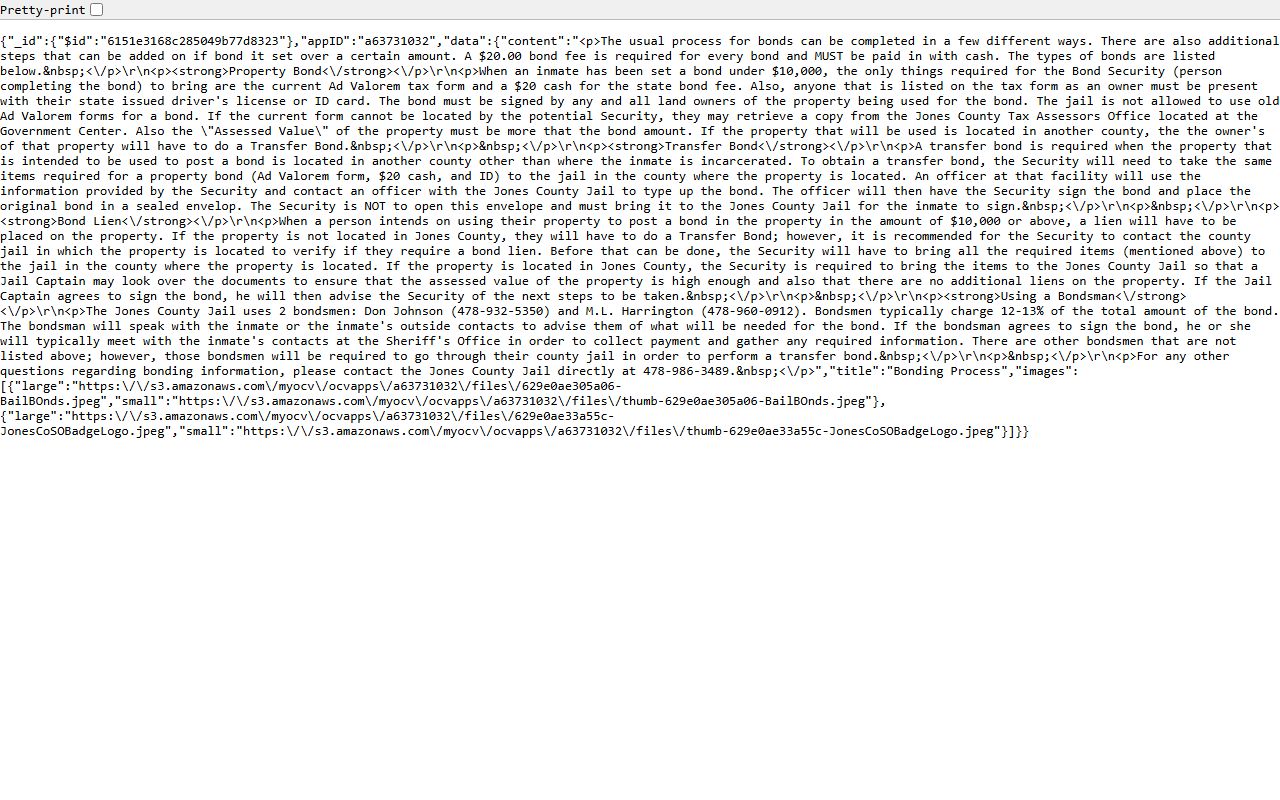
Bond information helps explain release status, but it does not prove whether a court charge ended in dismissal, plea, trial, or sentence.
Jones County Charges vs Convictions
Charges are accusations. Convictions are outcomes. Jones County arrest records, inmate feed entries, and warrant-related bookings can show charge language before the court reaches a final result. A conviction appears only after a guilty plea, guilty verdict, or other finding that establishes guilt. That distinction is central when reading court charge records after arrest, because the first public entry may look serious but later change through prosecution, plea talks, dismissal, or trial.
| Point | Charge | Conviction |
|---|---|---|
| Meaning | Allegation or count listed after arrest or filing. | Final finding or plea establishing guilt. |
| Timing | Can appear at booking, first appearance, accusation, or indictment. | Appears after plea, verdict, or other final disposition. |
| Record source | Sheriff feed, Magistrate Court, DA filing, or clerk case file. | Clerk disposition, sentence, probation order, or criminal-history report. |
| Risk when misread | Can be mistaken for proof of guilt. | Can still require context, such as sentence, restriction, or appeal. |
Georgia Felon Search is a statewide criminal-history product. It is not the same as the Jones County Clerk of Superior Court case file. The Georgia Felon Search portal may help with statewide felony-history checks, while court-file details still come from the clerk or court record source.
Jones County Sheriff Charge Entries
The sheriff app and inmate feed can show charge language before a final court result exists. That is why a Jones County arrest record often starts with jail data, then needs a court-file check if the charge moves forward. The research also shows that the sheriff app includes wanted or missing posts, inmate search, inmate FAQ, bonding process, commissary, visitation, sex-offender links, and tip tools. Those app modules support custody and public-safety questions, not final case disposition.
The sheriff app also contains wanted and missing-person tools. The official app manifest listed the jail menu, inmate search, inmate FAQ, bonding process, commissary funds, inmate visitation, inmate communications, sex offenders, Crimestoppers, and wanted or missing features. The manifest capture from the Jones County Sheriff's Office app manifest shows why the app can expose records that are not obvious from a static county page.
When an arrest entry lists a probation violation, bench warrant, or similar charge text, the app and court file should be checked together.
Note: Sheriff app entries help identify booking charge text, but the final court disposition comes from the court record.
Jones County Charge Records Access
Georgia's Open Records Act, O.C.G.A. Section 50-18-70 et seq., favors inspection and copying unless a record is exempt, sealed, or confidential. The clerk's civil-record process cites O.C.G.A. Section 50-18-71 and states that the office will notify requesters within three business days about available records, fees, or reasons a request cannot be fulfilled in that period. Uniform Superior Court Rule 21 also matters because court records are public unless access is limited by law or proper sealing procedure.
Important: Online booking data can be incomplete or out of date; verify formal charges with the court that holds the case.
The Georgia Department of Corrections maintains a separate location listing for the Jones County Jail, which confirms the county jail location and jail phone channel.
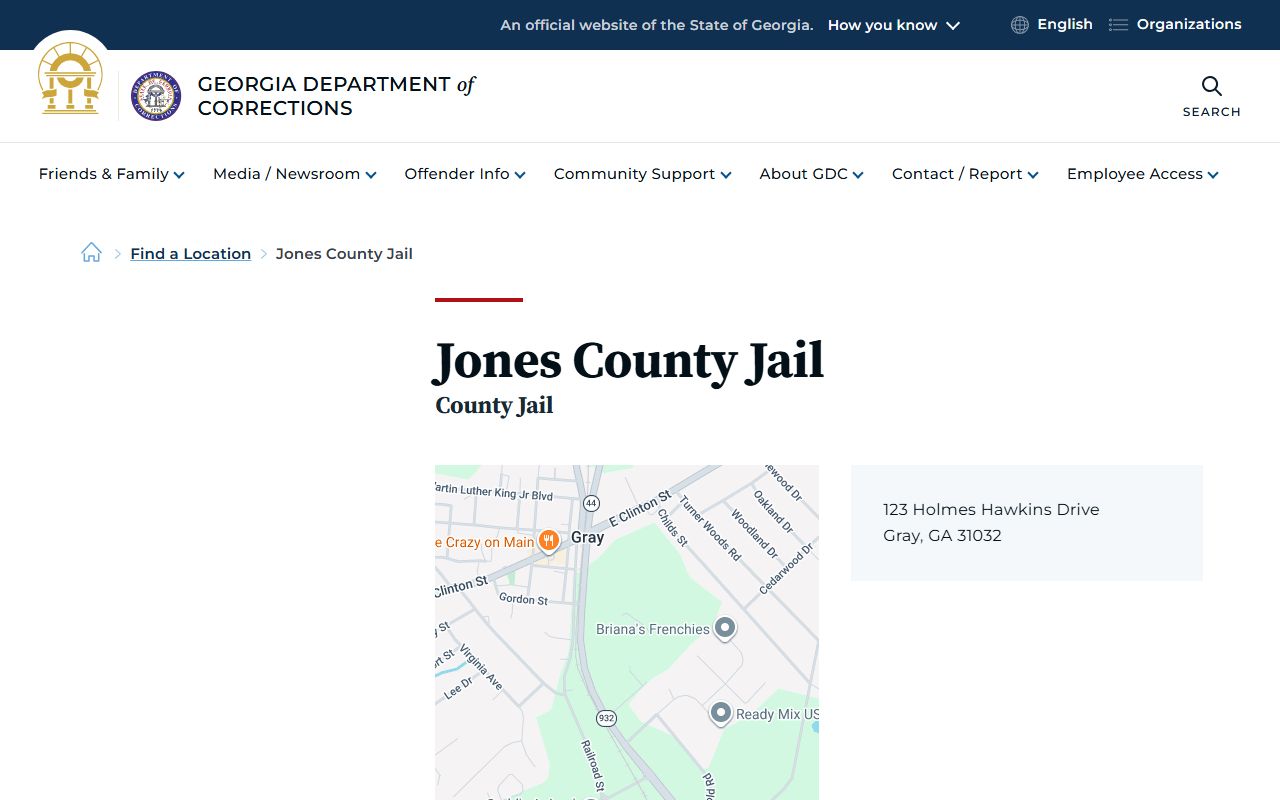
That state listing supports jail contact checks, but filed charge records remain with the court or prosecutor process that created the case.
Restricted Jones County Arrest Records
Not every Jones County arrest or charge record is open in the same way. Juvenile records are narrower than adult criminal records. Adoption records are generally confidential. Mental-health and involuntary-hospitalization matters in Probate Court should be treated as restricted unless the court confirms public access. Sealed records are not available through ordinary public search. Public copies may also need redaction of personal identifiers such as Social Security numbers, financial account numbers, and protected minor or victim information.
| Record Type | Public Access Issue | Research-Based Route |
|---|---|---|
| Restricted criminal history | Georgia law can limit dissemination for eligible records. | Use the GBI process under O.C.G.A. Section 35-3-37. |
| Sealed court file | Ordinary public search should not reveal the file. | Confirm with the clerk or court order process. |
| Juvenile charge | Access is narrower than adult criminal cases. | Use court-authorized access only. |
| Booking charge | May not show final disposition. | Check the court case for plea, dismissal, or sentence. |
The GBI record-restriction page explains that many records require prosecutor approval. For arrests after July 1, 2013, GBI directs people to contact the prosecutor rather than file a GBI application; older arrests may require an application at the arresting agency.
Jones County Arrest Charge FAQ
The sheriff's inmate FAQ is useful for bond, court-date, visitation, phone, commissary, and medication questions tied to an arrest. The manifest capture from the official inmate FAQ feed shows that some practical arrest-charge details are maintained through sheriff app content rather than the court clerk.
Use that FAQ for jail process questions, then use the court record to confirm the legal status of each filed charge.
- Does a listed charge prove conviction?
- No. It can be a booking charge, warrant entry, filed count, or pending accusation. The disposition answers whether it became a conviction.
- Where do court charges after arrest become formal?
- Formal prosecution is handled through the DA and court filing process, with Superior Court handling felony criminal cases in Jones County.
- Can a charge disappear from public search?
- Some records may be sealed, restricted, juvenile, or otherwise confidential. Dismissed or restricted criminal-history records need careful source-by-source review.